Building a Log Home in Japan: Why You Should Allow at Least Two Months for Building Confirmation
When planning a log home in Japan, the construction schedule matters just as much as the design and budget. Since the April 2025 reforms to Japan’s Building Standards Act and Building Energy Efficiency Act, it is no longer realistic to assume that work can begin as soon as the drawings are complete.
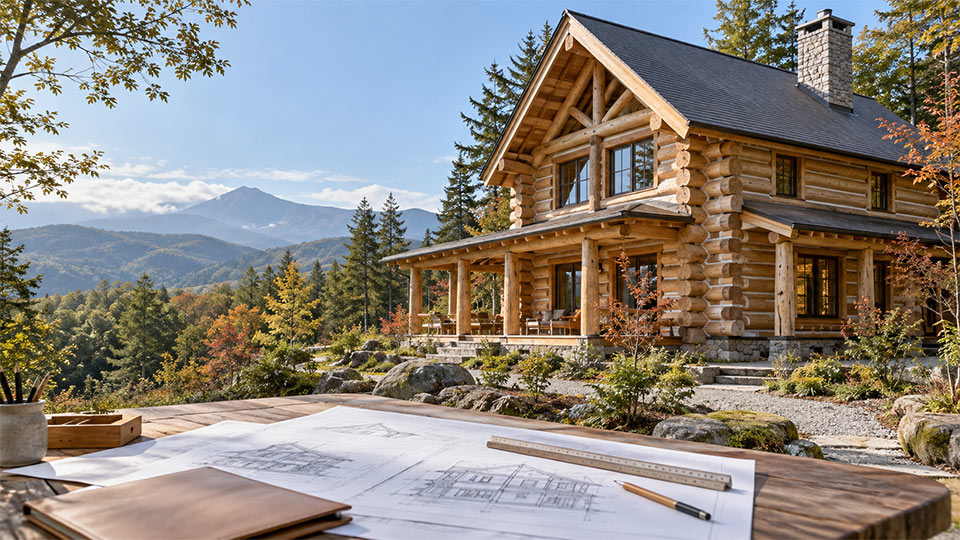
For a custom log home, allow at least about two months between submitting the building confirmation application and receiving the Certificate of Confirmation (確認済証). Allow more time where the design is complex, documents need revision, a separate energy assessment is required, or the reviewing body has a backlog.
Two-story log homes now receive a fuller review
Japan’s former small-building review exemption was significantly narrowed in April 2025. A two-story timber home, or a timber home with a total floor area of more than 200 m², is generally classified as a New Category 2 Building (Shin 2-gō).
These homes require more structural and energy-related information than many small homes did previously. For a custom log home, large openings, roof form, lofts or double-height spaces, decks, connection details, wall build-up and insulation can all affect the supporting documents. A late design change can trigger further coordination or recalculation before the application can move forward.
Building confirmation is not a one-month guarantee
Building confirmation is Japan’s statutory pre-construction code-compliance review. A building official or a private-sector Designated Confirmation and Inspection Body checks the plans against the applicable regulations. Once the plans are confirmed, the reviewing authority issues a Certificate of Confirmation (確認済証). Construction may start only after this certificate is issued; it is not the same as the final inspection certificate issued after construction.
For a New Category 2 application formally accepted by a local-government building official, the statutory review period is generally 35 days. This is not a guaranteed calendar turnaround or a cap on the whole waiting period. Pre-application consultation, requests for clarification, revised documents, specialist coordination, agency workload and resubmission can all add time.
Private Designated Confirmation and Inspection Bodies do not operate under the same statutory timetable, so turnaround times vary by organization and project. In a 2025 Ministry of Land, Infrastructure, Transport and Tourism survey of 15 private reviewing bodies, the average elapsed time from preliminary review to certificate issuance was approximately 39 days. This was neither a nationwide average nor a maximum; individual projects can take more than two months.
Energy compliance can affect the certificate date
New homes in Japan generally must comply with energy-efficiency standards. This does not mean every log home requires a separate energy-efficiency conformity assessment (省エネ適判). A home that demonstrates compliance through prescribed specifications for both the thermal envelope and primary energy use, for example, may qualify for a route without a separate assessment.
Where a separate assessment is required, it can progress in parallel with building confirmation. However, the assessment notice must be submitted before the Certificate of Confirmation can be issued. Changes to the wall and insulation specification, windows, roof form, heating, hot-water equipment or ventilation can affect the energy documents. If these elements change late in the process, recalculation and revised documents may delay the start date.
In legally specified circumstances, including some involving the timing of a required energy-assessment notice, a local-government building official may extend the 35-day review period by up to a further 35 days. This creates a possible statutory framework of up to 70 days.
This is not a simple addition of 35 days for building confirmation and 35 days for energy assessment. Nor is 70 days a universal maximum for the real-world process: preliminary review, amendments, congestion and resubmission may make the overall waiting period longer.
Plan your start date around the certificate—not the drawing completion date
Do not build your schedule around a one-month approval window. Once the core design is frozen, allow at least two months before construction, and more time for a larger or more complex home, a separate energy assessment, or a busy review body.
Settle the roof and glazing layout, insulation strategy, structural concept, building services and deck or porch details early. For a custom log home, these decisions affect structure, energy compliance, manufacturing and site work at the same time. Early coordination between the architect, structural designer and energy specialist is the most reliable way to avoid unnecessary delay.
For a log-home project in Japan, use the expected Certificate of Confirmation issuance date—not the date when the drawings are finished—as the key milestone for your construction schedule. At Hearthstone Homes Japan, we help clients plan around both the design and a realistic approval timetable.