How to Monetize a Log House as a Short-Term Rental【Ep3】
Land Selection, Legal Requirements, and Financial Planning for Profitable Operation
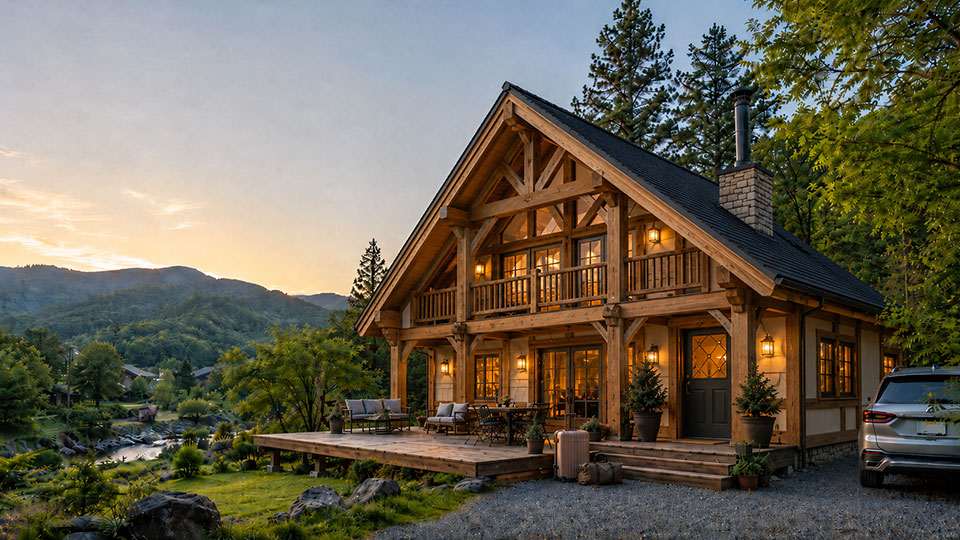
In Ep. 1, we discussed how using a log home as a short-term rental or private vacation rental can create opportunities that go beyond a purely private vacation home.
In Ep. 2, we looked at the importance of planning the design, floor plan, and target guests from the beginning when the goal is to generate income.
In this final episode, we will look at the key factors required to aim for profitable operation: land selection, legal requirements, financial planning, and how the log home can also serve as a future relocation destination or long-term residence.
Profitable Log Home Rentals Start with the Right Land
When using a log home as a short-term rental or vacation rental, location is one of the most important factors.
No matter how attractive the log home is, monetization becomes difficult if there is little accommodation demand in the area. On the other hand, if the land has strong appeal and matches existing travel demand, the unique character of a log home can become a powerful advantage.
Land that is suitable for rental operation often shares several characteristics.
It may be close to a tourist destination or hot spring area. It may offer easy access to ski resorts, lakes, beaches, hiking trails, campgrounds, or other outdoor attractions. It may be reachable by car from a major city, making it suitable for weekend trips. It may also have restaurants, supermarkets, and daily conveniences nearby, and remain accessible even in winter. In addition, it is important that local property management companies and cleaning services can realistically support the operation.
Land with these conditions is easier for guests to use and easier for owners to manage.
On the other hand, some land requires caution even if the scenery is beautiful. For example, land with roads that are too narrow, areas that are difficult to access by car in winter, locations with very limited shopping or medical access, areas with little nearby accommodation demand, or places where cleaning and emergency response services are difficult to arrange may create operational challenges.
For a log home short-term rental, natural beauty alone is not enough. Accessibility, manageability, and tourism demand must all be considered together.
Legal Requirements Should Be Confirmed Before Building
If you plan to use a log home as accommodation in Japan, legal requirements must be checked carefully.
In Japan, short-term rental and vacation rental operation may generally fall under several frameworks, including notification under the Private Lodging Business Act, permission under the Hotel Business Act, or special-zone private lodging systems in certain areas.
Operation under the Private Lodging Business Act can be relatively accessible, but it is subject to an annual operating limit of 180 days. For those who wish to operate more seriously as an accommodation business, a simple lodging business license under the Hotel Business Act may be considered. However, this requires checking building structure, fire safety equipment, hygiene standards, zoning, local ordinances, and other conditions.
The important point is this: you should not assume that you can simply build the log home first and obtain permission for short-term rental operation later.
Depending on the building design, floor plan, entrances and exits, evacuation routes, fire safety equipment, guest room area, management system, and land-use zoning, it may be difficult to convert the property into accommodation after construction.
In other words, if you want to use a log home as a short-term rental or vacation rental, you should confirm whether accommodation operation is possible in that area before purchasing land or before starting the design process.
Financial Planning Should Focus on Net Profit, Not Just Revenue
When planning a short-term rental or vacation rental, it is easy to focus on the nightly rate or annual revenue.
However, what really matters is how much profit remains after expenses.
For example, even if annual revenue looks attractive, the final profit can change significantly after deducting cleaning fees, booking platform commissions, property management fees, utilities, internet costs, consumables, repairs, insurance, property tax, tax filing costs, and other operating expenses.
If a loan is used, monthly repayments must also be included in the calculation.
A realistic financial plan should carefully consider annual occupancy, average nightly rate, average number of guests, cleaning costs, booking platform fees, management fees, utilities, internet, consumables, repair reserves, property tax, insurance, loan repayments, and the number of days the owner plans to use the property personally.
It is also important to remember that the owner’s preferred usage dates may overlap with peak travel periods. For example, Obon holidays, New Year holidays, long weekends, ski season, and autumn foliage season may be periods when nightly rates can be higher. However, these may also be the times when the owner wants to use the property personally.
Finding the right balance between private use and rental income is something that should be considered from the beginning.
Profitable Operation Is Possible, But It Must Be Treated as a Business
If operated successfully, a log home short-term rental may do more than cover part of the construction and maintenance costs. It may also become profitable on an annual basis.
However, this does not mean that a log home will automatically make money just because it is built.
To aim for profitable operation, several elements must work together: a location with accommodation demand, an attractive building, appropriate pricing, strong photography, a clear and appealing booking page, a clean interior, a stable cleaning system, review management, regular maintenance, and legal compliance.
In other words, a log home short-term rental is not just a side-income idea. It is a small accommodation business.
If it is planned as a business, it may help reduce the financial burden of construction and, in some cases, generate income. However, if the plan is vague, the property may not achieve the expected occupancy, and the owner may be left with ongoing maintenance costs.
That is why design, location, operation, financial planning, and legal requirements should all be considered together before construction begins.
It Can Also Become a Future Relocation Destination or Long-Term Home
The appeal of a log home short-term rental is not limited to income generation.
While the owner is younger or still based elsewhere, the property can be owned as a second home and rented out as a vacation rental during unused periods. Later, when work or family circumstances change, it can become a base for dual-location living. Eventually, it may even become a relocation destination or long-term home.
This kind of long-term flexibility is one of the great advantages of a log home.
If you think of the property only as a private vacation home, it may feel like a luxury. However, by combining private use with short-term rental operation, you can reduce the financial burden during the ownership period while also creating future lifestyle options.
A log home does not have to be a house for immediate full-time relocation. It can also be a way to prepare for your future life in Japan while using the property as an income-generating asset in the meantime.
Conclusion: A Log Home Short-Term Rental Can Help Turn a Dream into Reality
You may want to build a log home, but feel uncertain about the budget. You may already own a house or condominium, making it difficult to justify building another home purely as a vacation property. You may also want to use it someday as a relocation destination or long-term home, but worry about the maintenance costs until then.
For people in this situation, short-term rental or vacation rental operation can be a realistic way to bring log home construction closer to reality.
If the log home is used only privately, it remains a major expense. However, by renting it out during unused periods, there may be opportunities to recover part of the construction and maintenance costs. Depending on the location and operation, it may even be possible to aim for profitable income.
The key is not to think of the project as something that ends once the log home is built.
Accommodation demand should be considered from the land selection stage. Rental operation should be included in the design process. Legal requirements should be confirmed in advance. Cleaning and management should be planned realistically. Financial planning should be based on actual net profit. The target guest should be clearly defined.
When these points are considered properly, a log home can become more than just a dream vacation home. It can become an asset that supports both future lifestyle plans and income generation.
For those who have always thought, “Someday I would like to build a log home,” the budget may not be the only factor determining whether that dream can move forward.
By incorporating short-term rental operation into the plan, a log home can become more realistic, more strategic, and more financially positive.
A log home that you can enjoy personally, that guests will choose, and that can generate income.
That may be one of the new ways to own a log home in Japan.









