What Hidden Extra Costs Should You Expect When Building a Log Home in Japan?【Ep.1】
Understand the “unexpected costs” beyond construction before you commit.
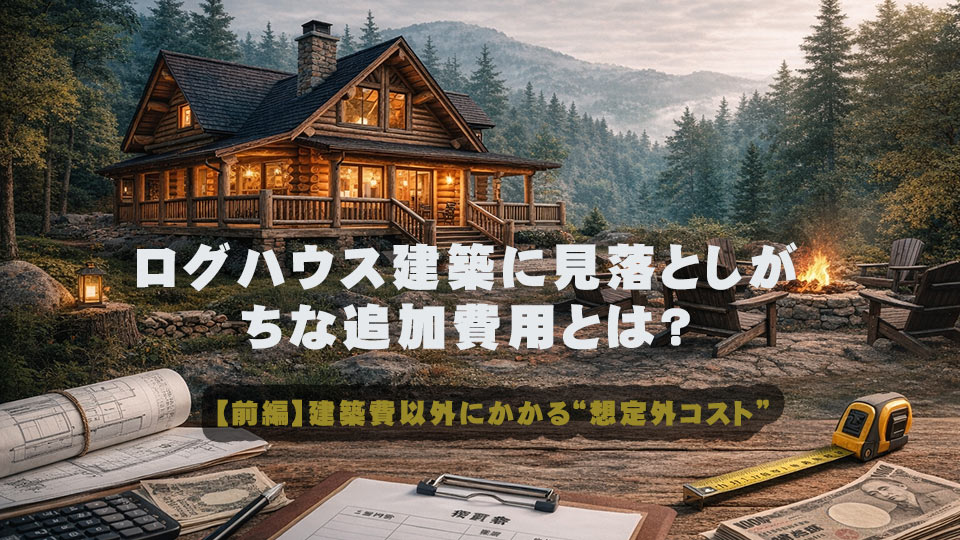
When people begin planning a log home in Japan, the first numbers they usually focus on are the base building price or the cost per square meter. Those are important starting points, but in reality, the total cost of building a log home often includes several additional expenses beyond the home itself.
Knowing these hidden costs in advance can make a major difference in how confidently you plan your budget. This is especially true in Japan, where log homes are often built in natural settings, resort areas, rural locations, or sloped sites. In these environments, land conditions and infrastructure can have a much greater impact on cost than many buyers initially expect.
In this first article, we will look at the foundational extra costs that are most commonly overlooked when building a log home in Japan.
Why do log homes in Japan often involve extra costs?
Compared with a standard suburban house, a log home is more likely to be affected by conditions outside the building itself.
For example, if your land is in a forested area or on a slope, you may need site clearing, tree removal, grading work, or special delivery arrangements for materials. In some rural or resort locations in Japan, utility infrastructure such as water, drainage, or electricity may also be limited, which can lead to separate connection costs.
In addition, many of the features people love about log homes—such as wood stoves, decks, and natural-style exterior works—are often not included in the standard quoted price. That is why one of the most important parts of planning a log home in Japan is identifying the costs that do not appear clearly in the initial estimate.
1. Land preparation costs
The more attractive the site, the more preparation it may need
Many buyers looking to build a log home in Japan are drawn to scenic lots surrounded by trees, elevated land with views, or villa-style sites in mountain and resort areas. However, these beautiful locations are often not immediately ready for construction.
If the site has many trees, tree cutting and stump removal may be necessary. If the land has level differences, you may need grading, soil retention work, or even retaining walls. In some cases, there are also costs for disposing of cut trees, removing excess soil, or carrying out manual work where heavy machinery cannot easily enter.
Common additional land preparation costs include:
- Tree cutting and stump removal
- Site grading and leveling
- Disposal of excess soil
- Retaining walls and soil support work
- Access road preparation
- Parking area construction
When buying land in Japan, it is easy to focus on scenery and atmosphere. However, checking the cost of preparing the land for actual construction is essential if you want a more realistic total budget.
2. Soil investigation and ground improvement
Owning land does not always mean the ground is ready to build on
A log home may look lighter than other types of homes because it is made of wood, but stable ground is still critical for long-term durability and structural safety.
For that reason, soil testing is typically carried out before construction. Depending on the results, additional ground improvement work may be required. One important point here is that ground improvement costs are often unknown at the early quotation stage. Until testing is completed, it may not be clear whether improvement is necessary.
If ground improvement is required, the cost may range from several hundred thousand yen to several million yen depending on the site conditions.
Particular caution is needed for land with the following characteristics:
- Filled land or possible backfilled ground
- Sloped sites
- Land where a building previously stood
- Sites with possible buried debris or underground obstructions
- Land that appears stable on the surface but contains weak layers below
When budgeting for a log home in Japan, it is wise not to assume that ground improvement costs will be zero.
3. Utility connection costs for water, electricity, and drainage
One of the most commonly overlooked expenses not included in the main construction quote
If your log home site is located in the countryside, a resort area, or a less developed part of Japan, utility infrastructure may not be fully in place.
This is where many people underestimate costs. Internal plumbing and wiring inside the home may be included in the building estimate, but the cost of bringing utilities from outside the property into the site is often treated as a separate item.
Examples of commonly overlooked utility-related costs include:
- Water supply connection from the main line
- Well drilling
- Electrical connection work
- Septic tank installation
- Propane gas equipment
- Drainage route preparation
In parts of Japan where there is no public sewer system, a septic tank may be required. Depending on the land, not only the tank itself but also excavation difficulty, equipment access, and installation conditions can affect the final cost.
The more natural and remote the location, the more important it is to verify infrastructure costs early.
4. Foundation cost increases
Standard foundation specifications may not be enough
Foundation work for a log home in Japan may change depending on the site conditions and the local climate.
For example, a sloped site may require different foundation heights across the building. In cold regions such as Hokkaido or other snowy areas, additional insulation or freeze protection may also be necessary. On damp sites, greater attention may need to be given to ventilation and underfloor moisture control.
Because of these conditions, the standard foundation specification assumed in the initial estimate may not be sufficient, and costs can rise.
Examples of possible additional foundation-related costs include:
- Changing to a higher foundation
- Foundations adapted to sloped land
- Cold-climate foundation insulation
- Reinforced moisture-control measures
- Increased labor due to difficult site conditions
The foundation is one of the most critical parts of the entire home. Since it is difficult to change later, it is important to plan not only for cost, but also for long-term stability and peace of mind.
Summary of Ep1
When thinking about the hidden extra costs of building a log home in Japan, the first items to understand are the ones tied to the basic conditions of the project: the land, the ground, the utility infrastructure, and the foundation.
These expenses are not always visible in the finished appearance of the home, but they can have a major impact on your total building budget.
If you only focus on the base construction price, unexpected expenses may appear as the project moves forward, forcing you to adjust your budget later. That is why, when planning a log home in Japan, it is not enough to think only about what kind of home you want to build. You also need to think carefully about where you are building, and under what conditions.
In Ep2, we will look at more commonly overlooked costs, including wood stoves, exterior works, delivery and crane access, permit-related costs, furniture and appliances, and long-term maintenance after the home is completed.









