Allergy-Friendly Log Home Living in Japan【Ep.2】
Preventing Sick House Syndrome, Mold, Humidity, and Indoor Air Problems
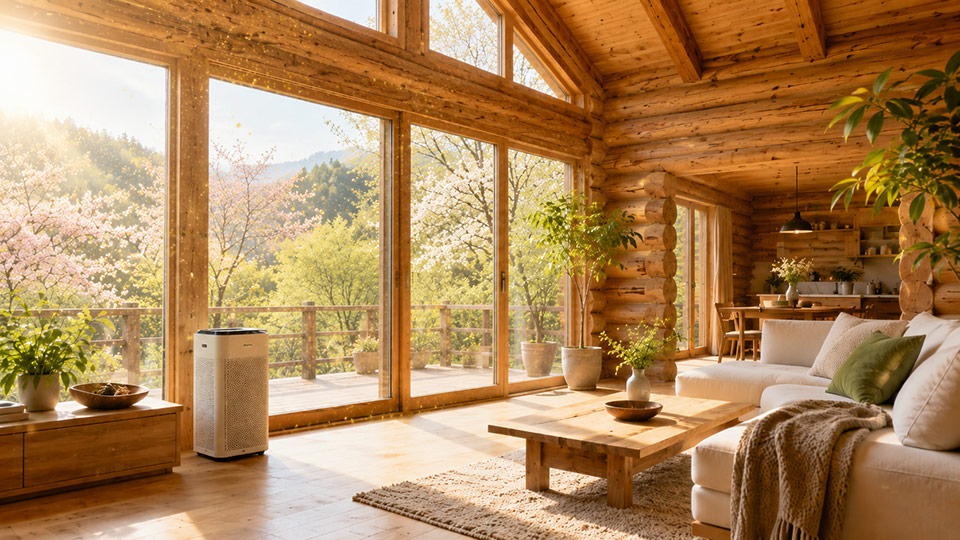
In Ep. 1, we looked at the basics of pollen control in a log home, including how to prevent pollen from entering the home, how to plan the entrance and laundry flow, and how to reduce house dust.
In Ep. 2, we will go further and look at sick house syndrome, mold, humidity, condensation, and ventilation planning.
A log home uses a large amount of natural material, but that does not mean indoor air quality can be ignored. To live comfortably and healthily over the long term, it is important to consider materials, construction, ventilation, humidity control, and maintenance as one connected system.
Sick House Syndrome and Log Homes
Sick house syndrome refers to symptoms such as eye irritation, nasal irritation, throat discomfort, skin irritation, headaches, or fatigue that may be related to indoor air quality. Possible causes include chemical substances emitted from building materials, adhesives, paints, furniture, interior finishes, and insufficient ventilation.
Common sources of indoor chemical exposure may include plywood, adhesives, vinyl wallpaper, paint, flooring materials, furniture, and other interior products. Modern building materials are more regulated than in the past, but indoor air quality still requires attention, especially in homes with poor ventilation.
One advantage of a log home is that solid wood can be used as both structure and finish. This can reduce the need for large amounts of wallpaper, plasterboard finishes, or additional interior materials. In that sense, a log home can make it easier to create a home with fewer layered synthetic finishes.
However, this does not mean that log homes are completely unrelated to sick house syndrome.
Even in a log home, paints, stains, adhesives, flooring products, insulation, windows, doors, kitchens, cabinets, and furniture may all contain various materials. Therefore, it is not enough to say, “It is a log home, so indoor air quality will automatically be safe.”
The important point is to choose materials carefully and design the home so that it can be properly ventilated. In particular, newly built homes may have lingering smells from materials or furniture, so planned ventilation and air exchange are important after completion.
Mold, Humidity, and Condensation Can Trigger Allergies
Along with pollen, mold is one of the major indoor air concerns related to allergies and respiratory symptoms.
Mold tends to grow in humid areas such as bathrooms, washrooms, kitchens, closets, window areas, underfloor spaces, and surfaces where condensation occurs.
In a log home, wood naturally reacts to changes in humidity. When properly designed and maintained, this can contribute to a comfortable indoor environment. However, if moisture is allowed to remain trapped, it can lead to mold, staining, and even wood decay over time.
Japan’s climate makes this especially important.
The rainy season and humid summers can create moisture problems. In mountainous areas or forested locations, morning and evening temperature differences, fog, shade, and reduced sunlight can make it more difficult for moisture to dry out.
For this reason, log homes in Japan require careful planning for roof overhangs, rain protection, foundation ventilation, underfloor airflow, bathroom and washroom ventilation, window insulation, and heating.
It is not enough to focus only on the atmosphere or appearance of the home. A good log home should be designed with a clear understanding of where moisture may accumulate.
This is one of the keys to creating an allergy-friendly log home.
Ventilation Planning Determines Indoor Air Quality
Ventilation is essential when thinking about indoor air quality in a log home.
Even if you want to keep pollen outside, you cannot simply avoid ventilation. Without proper ventilation, humidity, odors, carbon dioxide, chemical substances, and moisture that can lead to mold may remain inside the home.
On the other hand, opening windows without planning can bring in pollen, yellow dust, PM2.5, and insects.
That is why ventilation in a log home should be considered as a combination of mechanical ventilation, air intake locations, filters, window ventilation, and air purifiers.
For people with hay fever or allergies, it is useful to check the filter performance of air intake vents and how easy they are to clean or replace. Filters do not work properly forever. If they are not cleaned or replaced regularly, their performance will decline.
Air purifier placement is also important. During pollen season, if windows are opened for ventilation, placing an air purifier in a suitable location near airflow paths can help reduce pollen that enters the room.
Key Points for an Allergy-Friendly Log Home
If you have hay fever or allergies and are planning to build a log home, several design points are worth considering.
First, create an entrance area that stops outdoor items before they reach the main living space. A mudroom, coat storage, shoe storage, and a hand-washing route can help reduce pollen and dust entering the home.
Second, choose finishes that are easy to clean. Large areas of carpet and excessive fabric surfaces can collect pollen and house dust. Wooden floors, washable rugs, and easy-to-clean furniture are often easier to manage.
Third, plan carefully for humidity. Bathrooms, washrooms, kitchens, underfloor areas, closets, and window areas should not trap moisture. Ventilation, insulation, and heating all need to work together.
Fourth, make maintenance easy. Log homes require regular checks of exterior walls, decks, eaves, window areas, chinking, sealing, and other details. A design that is easy to inspect and maintain can help prevent mold, moisture damage, and deterioration, while also supporting healthier indoor air quality.
Conclusion: Indoor Air Quality Should Be Part of Log Home Design
Comfortable log home living during pollen season requires more than simply placing an air purifier in the room.
A truly allergy-friendly log home should be planned as a complete living environment. This includes an entrance that helps keep pollen outside, floors and furniture that are easy to clean, indoor drying or laundry space, ventilation filters, humidity control, mold prevention, and careful material selection to reduce indoor air concerns.
A log home is a wonderful way to enjoy natural materials. The warmth, scent, texture, and visual beauty of wood are major advantages that ordinary homes often cannot provide.
However, because log homes are closely connected to nature, it is important to deal carefully with pollen, humidity, mold, house dust, and indoor chemical exposure.
From now on, good log home design in Japan should consider not only the beauty of the timber and the design of the house, but also the quality of the air people breathe inside.
An allergy-conscious log home can be comfortable not only in spring, but also during the rainy season, summer, autumn, and winter.
A home where you can enjoy nature outside, while breathing comfortably and safely inside.
That is one of the new forms of log home living needed in Japan today.