Pest Control and Log Protection for Log Homes in Japan【Ep.2】
Practical Design and Maintenance Methods for Keeping Insects Out and Protecting the Logs
In Ep. 1, we looked at the basic relationship between log homes, insects, termites, moisture, and wood protection.
In Ep. 2, we will focus on practical measures that can be considered during design, construction, and maintenance.
Pest control for a log home is not only about using chemicals or calling a pest control company after insects appear. It is much more effective to reduce the conditions that attract insects and to close the possible entry points from the beginning.
For log homes in Japan, this means thinking carefully about exterior lighting, chinking and sealing, roof eaves, ventilation openings, landscaping, wood-protection coatings, and regular inspections.
Lighting Plans That Attract Fewer Insects
Many log homes are built in natural settings, where outdoor lighting can attract insects at night.
Stink bugs, moths, and other insects may gather around entrance lights, deck lights, porch lights, and exterior wall lights. If strong lights are installed close to windows and doors, insects attracted to the light may easily enter the house when the door or window is opened.
This is why outdoor lighting should be considered as part of pest prevention.
Instead of placing strong lights directly beside windows or entrances, it is better to plan the location and direction of lighting carefully.
Warm-colored lighting may also be preferable to bright white lighting in many outdoor areas. Warm light often creates a softer atmosphere that suits log homes well, and it may help reduce the number of insects attracted to the light.
Motion-sensor lights can also be useful. Rather than leaving exterior lights on all night, they turn on only when needed. This can help reduce insect activity around the house while still providing safety and security.
For a log home, exterior lighting is not only about design. It can also affect how many insects gather near the building.
The Importance of Chinking and Sealing
Chinking and sealing are essential parts of many log homes, especially dovetail log homes and traditional log homes with visible joints.
Chinking is not just a decorative feature. It helps fill the gaps between logs, improves air tightness, and reduces entry points for rain, wind, and insects.
Because wood expands and contracts with changes in temperature and humidity, small gaps may appear over time. Even if the building was well sealed when it was first completed, regular inspection is still important.
Small gaps around logs, corners, windows, doors, and utility penetrations can become entry points for stink bugs, ladybugs, ants, spiders, and other small insects.
If water enters through these gaps, it may also lead to wood deterioration, mold, or decay.
For this reason, log home owners should regularly check:
- Cracks in chinking
- Loose or peeling sealant
- Gaps around windows and doors
- Openings around log corners
- Damaged sealant around pipes or exterior fixtures
Good chinking and sealing help protect both the indoor comfort of the house and the long-term durability of the logs.
Deep Roof Eaves Help Protect the Logs
Roof design is very important for log homes in Japan.
A generous roof overhang helps protect the log walls from direct rain and strong sunlight. This is especially important in Japan, where heavy rain, typhoons, humid summers, and snowy winters can place stress on exterior wood.
When roof eaves are too short, rainwater can hit the log walls directly. Over time, this may increase the risk of staining, cracking, moisture retention, and decay.
Deep eaves can help protect:
- Exterior log walls
- Chinking and sealant
- Window and door areas
- Deck connections
- Lower wall sections
They can also reduce direct summer sunlight, helping the indoor environment remain more comfortable.
For log homes, roof eaves are not only a design feature. They are part of the building’s protection system.
A well-designed roof helps the logs stay drier, and drier logs are less attractive to termites and decay-related problems.
Protecting Vents and Air Openings
Insects can enter a home through very small openings.
Windows and doors are obvious entry points, but vents and utility openings are also important.
Log homes may have intake vents, exhaust vents, foundation vents, underfloor ventilation, attic ventilation, air-conditioning pipe penetrations, electrical penetrations, and plumbing penetrations.
These openings are necessary for the building, but they should be protected properly.
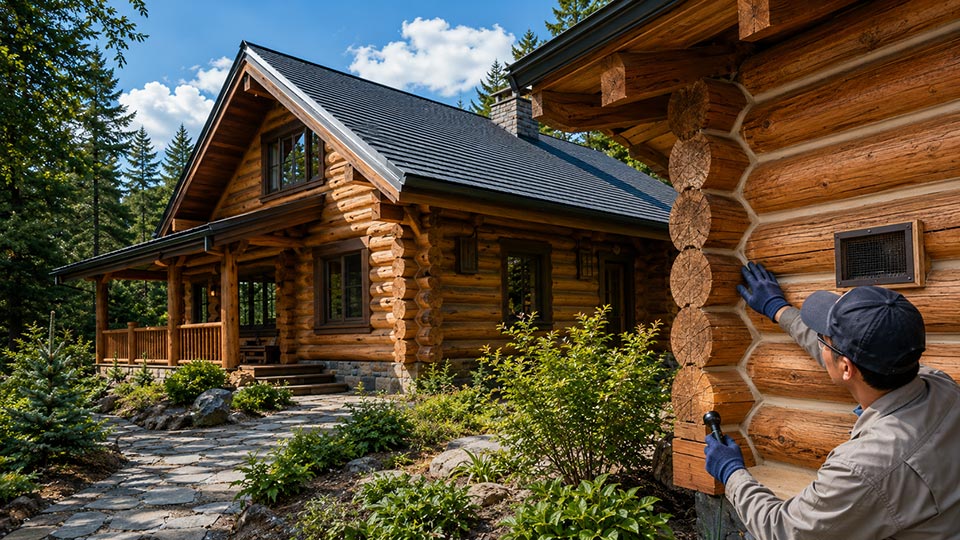
Vent covers, insect screens, mesh, and well-sealed pipe penetrations can help reduce insect entry. However, these parts also need maintenance. If screens become damaged or clogged with dust, leaves, or insects, they may no longer work properly.
It is also important not to block ventilation completely. Ventilation is necessary to control moisture, which is directly connected to wood protection and termite prevention.
The goal is not to stop airflow.
The goal is to allow proper ventilation while preventing insects from entering.
Keeping Trees and Vegetation Away from the Building
Log homes look beautiful when surrounded by trees and plants. However, if vegetation is too close to the building, it can increase moisture and pest risks.
Branches that touch the roof or exterior walls can provide a pathway for insects. Leaves that fall onto the roof or into gutters can hold moisture. Dense plants around the foundation can reduce airflow and make inspection more difficult.
For a log home, the area immediately around the building should be easy to inspect and maintain.
It is best to avoid:
- Tree branches touching the roof or walls
- Dense shrubs directly against the foundation
- Leaves collecting in gutters
- Firewood stacked against the exterior wall
- Dead wood or debris left under decks
- Plants blocking airflow around the base of the house
This does not mean that the landscape must be empty. A log home should still feel connected to nature. However, there should be enough space around the building for air circulation, maintenance, and inspection.
A beautiful landscape and a well-protected log home can exist together, but the distance between vegetation and the building must be planned carefully.
Wood Protection and Anti-Termite Treatments
Exterior wood protection is one of the most important parts of log home maintenance.
Stain, wood preservative, and anti-termite treatments can help protect the logs from ultraviolet light, rain, moisture, decay, and insect-related risks.
However, no coating lasts forever.
Sunlight, rain, wind, snow, and temperature changes slowly reduce the performance of exterior finishes. South-facing and west-facing walls, exposed corners, deck areas, window bottoms, and lower wall sections often require closer attention.
For log homes in Japan, regular maintenance may include:
- Checking the exterior stain condition
- Reapplying protective coatings when needed
- Checking water repellency
- Inspecting lower logs and corners
- Monitoring areas near decks and foundations
- Confirming that termite treatment remains effective
- Repairing damaged chinking or sealant
Anti-termite and wood-preservation treatments should be selected carefully according to the location, climate, and intended use of the building.
The best protection is not a single product. It is a combination of good design, moisture control, proper materials, suitable treatment, and regular maintenance.
Regular Inspection Checklist
Regular inspection is the most important habit for keeping a log home in good condition.
Small problems are usually easier and less expensive to repair than major damage discovered too late.
For log homes in Japan, it is helpful to inspect the building at least once or twice a year, especially in spring and autumn.
Spring is a good time to check for damage after winter. Autumn is a good time to check gaps and entry points before stink bugs and ladybugs look for winter shelter.
Key inspection points include:
- Cracks or decay in exterior logs
- Fading or loss of water repellency in the exterior finish
- Cracks, gaps, or peeling in chinking and sealant
- Gaps around windows and doors
- Mud tubes or moisture signs around the foundation
- Damaged or clogged insect screens on vents
- Leaves or debris under decks
- Leaves clogging gutters
- Wasp nests or insect nests under eaves
- Firewood stored too close to the house
- Tree branches touching the roof or walls
- Dense vegetation blocking airflow
- Small insects entering from interior corners or window areas
If any issue is found, it is best to repair it early.
Log homes are strong and long-lasting when they are cared for properly, but they should not be left unchecked for many years.
Conclusion: Pest Control Is Part of Long-Term Log Home Maintenance
Pest control for a log home is not just about removing insects after they appear.
It is part of long-term building care.
Exterior lighting, chinking, sealing, roof eaves, vent protection, landscaping, wood-protection coatings, anti-termite treatment, and regular inspections all work together.
This is especially important in Japan, where many log homes are built in humid, natural environments.
A log home is not separated from nature. It is designed to live with nature. That is why owners need to understand how to manage insects, moisture, and wood protection.
With good planning and regular maintenance, a log home can remain beautiful, comfortable, and durable for many years.
The goal is not to eliminate nature from the home.
The goal is to enjoy nature while protecting the living space and the logs that make the home special.