Pest Control and Log Protection for Log Homes in Japan【Ep.1】
Basic Knowledge for Protecting Your Log Home from Stink Bugs, Ladybugs, Termites, and Other Pests
For many people, building a log home in Japan means living closer to nature.
A log home surrounded by trees, mountains, open land, or a quiet countryside setting can offer a lifestyle that ordinary houses rarely provide. The warmth of natural wood, the scent of timber, and the atmosphere of a handcrafted home are some of the biggest attractions of log home living.
However, living close to nature also means living closer to insects.
Some people who are considering a log home may wonder:
“Will a log home attract more insects?”
“Are termites a serious problem?”
“Will stink bugs or ladybugs come inside the house?”
“How can I protect the logs from damage?”
These are very natural concerns, especially in Japan, where the climate is humid, the rainy season is long, and many popular log home locations are in mountain or forest areas.
The good news is that most pest-related problems can be prevented or reduced with proper design, construction, and maintenance.
The important point is not to think, “Log homes always have insect problems.”
Instead, it is better to understand how insects enter buildings, what conditions attract them, and how to protect both the living space and the log structure.
Common Insects Around Log Homes
Several types of insects are commonly seen around log homes in Japan.
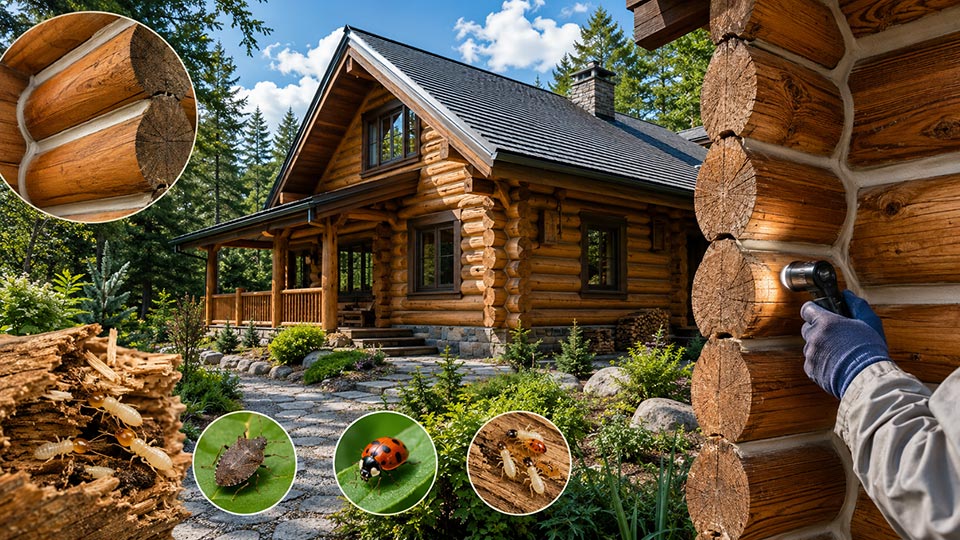
These may include stink bugs, ladybugs, termites, ants, spiders, moths, wasps, and wood-boring insects.
Among these, the two that often concern log home owners most are stink bugs and termites.
Stink Bugs
Stink bugs are especially common in rural, mountain, and forested areas.
They do not eat the log structure itself. However, in autumn, they often look for warm and sheltered places to spend the winter. As a result, they may gather around windows, roof eaves, exterior walls, and small gaps around the building.
If there are openings around windows, doors, vents, or the log joints, stink bugs may enter the house.
They are not usually a structural threat, but they can become a major nuisance when they appear in large numbers indoors.
Ladybugs
Ladybugs may sound harmless, but they can also gather around buildings in groups when looking for winter shelter.
Like stink bugs, they may enter through small gaps around windows, doors, and exterior joints. They usually do not damage the building, but if many of them enter the home, they can become unpleasant for the occupants.
This is why insect control in a log home is not only about protecting wood. It is also about preventing insects from entering the living space.
Termites
Termites require much more serious attention.
Unlike stink bugs or ladybugs, termites can damage wood. If termite prevention is ignored, they may affect structural members, flooring, or other wooden parts of the building.
However, this does not mean that log homes are the only buildings at risk. Any wooden house in Japan can be affected by termites if moisture, ground contact, or hidden entry routes are not properly controlled.
For a log home, termite prevention should begin before construction.
The building should be designed so that the logs and other wooden parts do not directly touch the ground. A proper concrete foundation, termite treatment, moisture control, and regular inspection are all important.
A Log Home Does Not Automatically Attract More Insects
One common misunderstanding is that insects appear simply because the house is made of logs.
In reality, the surrounding environment often has a much bigger influence than the building material itself.
A house built deep in the mountains, near a forest, close to farmland, or beside unmanaged vegetation will naturally have more insects around it than a house in a city. This is true even if the house is not a log home.
The main factors that influence insects are:
- Location
- Humidity
- Vegetation
- Sunlight
- Drainage
- Nearby woodpiles
- Building gaps
- Maintenance condition
In other words, pest control is not only a question of materials. It is also a question of site planning, building design, and ongoing care.
Termite Prevention Starts with Moisture Control
For termite prevention, one of the most important principles is to keep wood dry.
Termites and wood decay problems are more likely to occur when moisture is allowed to remain around the building.
In Japan, this is especially important because of the rainy season, typhoons, high summer humidity, and snow in colder regions.
Good termite prevention includes:
- Keeping wood away from direct soil contact
- Using a proper foundation
- Maintaining ventilation around the foundation and underfloor areas
- Avoiding water accumulation near the building
- Repairing leaks quickly
- Checking exterior logs and joints regularly
- Applying appropriate termite and wood-protection treatments when necessary
A log home should be designed so that rainwater drains away from the building and the logs can dry properly after rain.
In many cases, “termite prevention” and “moisture control” are almost the same conversation.
Protecting the Logs Also Helps Prevent Pest Problems
Log protection is not only about keeping the exterior beautiful.
Exterior stains and wood-protection coatings help protect the logs from rain, ultraviolet light, and repeated wet-dry cycles. When logs are exposed to too much moisture and sunlight without proper maintenance, cracks and gaps may appear more easily.
These gaps can become entry points for insects.
This is why regular wood maintenance is also part of pest control.
A well-maintained log wall is easier to protect. A neglected log wall can develop cracks, loose sealant, decayed areas, or hidden moisture problems that may attract pests or allow them to enter.
For log homes in Japan, exterior maintenance should be treated as part of the long-term ownership plan.
Summary of Ep. 1
Log homes may be located in places where insects are more common, such as forests, mountains, or countryside areas. However, this does not mean that log homes automatically have serious pest problems.
The key is to understand the difference between nuisance insects, such as stink bugs and ladybugs, and structural threats, such as termites.
For a comfortable and durable log home, the basic principles are:
- Prevent insects from entering the living space
- Keep the logs dry
- Control moisture around the building
- Protect the exterior wood
- Maintain chinking and sealing
- Inspect the building regularly
In Ep. 2, we will look at more specific prevention methods, including lighting plans, chinking and sealing, roof eaves, vent protection, distance from trees, wood-protection coatings, and regular inspection points.
Scheduled Release Date: September 15, 2026