What Makes a Log Home Age Beautifully?【Ep.1】
The Real Reason Some Homes Gain Character While Others Simply Look Old.
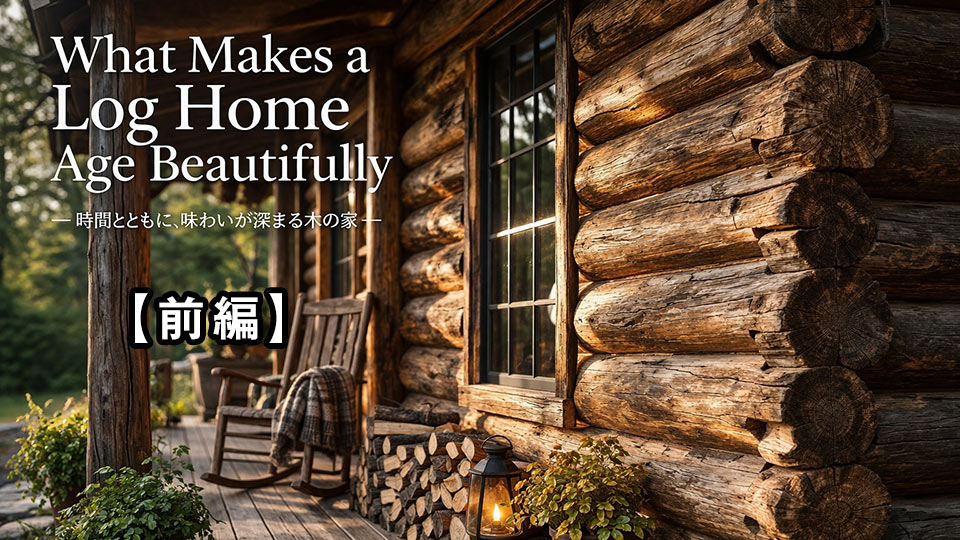
When considering building a log home in Japan, many buyers focus on the initial beauty of the property. However, the true value of a log home is not defined at completion.
Its real worth emerges over time.
As years pass, the timber gradually develops a richer tone, the reflection of light softens, and frequently touched surfaces gain a natural patina. These changes are unique to real wood and create a sense of depth and authenticity that cannot be replicated by industrial materials.
However, not all log homes age in the same way.
Some homes develop character and become more valuable over time, while others simply appear worn or outdated. The key difference is not the construction method itself, but how the surface of the wood is finished.
The Key to Beautiful Aging: Surface Depth and Texture
Whether a log home ages gracefully depends largely on how much depth and variation exists in the wood surface.
This includes:
- Natural shadows created by surface texture
- Marks of craftsmanship
- Subtle irregularities that diffuse light
- Depth within the wood grain
If the surface is flat and uniform, aging appears mostly as a change in color.
In contrast, when the surface has texture and variation, aging expresses itself through:
- Changing light reflection
- Enhanced three-dimensional appearance
- Development of natural sheen
These elements create visual depth and richness over time.
In other words, the ability of a home to gain character is directly linked to how three-dimensional the wood surface is from the beginning.
Creating “Room for Aging”: Hand-Hewn and Antique Finishes
For buyers considering a long-term investment in Japan, it is important to understand that beautiful aging does not happen by accident. It is intentionally designed into the material.
Two finishing methods are particularly effective:
- Hand-hewn surface finishing
- Antique surface finishing
Hand-Hewn Finish
Hand-hewn finishing is a traditional technique where skilled craftsmen use an adze (known as “chouna” in Japan) to carve the surface of pre-cut square logs by hand.
This process creates subtle, irregular textures that cannot be reproduced by machines. The surface interacts with light in a dynamic way, producing natural shadows and depth.
Because the surface is not overly refined at the outset, small scratches, wear, and color changes blend naturally into the material over time rather than standing out.
As a result, aging enhances the overall character of the home instead of diminishing it.
Antique Surface Finish
Antique finishing takes a different approach.
The surface of logs that are over 200 years old is carefully scanned in 3D, capturing every detail such as grain patterns, cracks, and marks accumulated over time. These characteristics are then transferred onto new logs using precision pressing techniques.
This allows newly built homes to replicate the visual depth and maturity of aged timber from the beginning.
Because the surface already contains variation and complexity, future aging integrates seamlessly into the existing texture. Changes over time do not disrupt the appearance, but rather deepen it.
Designed for Aging, Not Just Appearance
Both finishing methods share a common philosophy.
They are not simply aesthetic choices. They are designed to accommodate and enhance the effects of time.
Instead of creating a perfectly uniform surface, they introduce controlled irregularities and depth. This allows aging to be perceived as a natural evolution rather than deterioration.
For international buyers, this distinction is critical.
A home that ages well is not only more enjoyable to live in, but also more resilient in terms of long-term value and resale potential.
Why Dovetail Log Homes and Timber Frame Structures Work Best
It is important to clarify that the construction method itself does not create character.
However, certain structural systems allow these surface finishes to be applied more effectively.
Dovetail log homes and timber frame structures are particularly well-suited because they use:
- Large-diameter timber
- Thick, solid structural members
These characteristics make it possible to apply deeper carving and more expressive surface treatments.
In contrast, smaller components or laminated materials limit how much surface variation can be introduced.
This is why, in practice, dovetail log homes and timber frame structures are often associated with better aging performance. Not because of the structure alone, but because they provide the right conditions for these finishes.
Comparison with Standard Log Homes
Many conventional log homes use:
- Smooth planed solid wood
- Laminated timber materials
These options offer advantages such as:
- Dimensional stability
- Ease of construction
- Clean and uniform appearance
However, because the surfaces are highly refined and consistent, the visual impact of aging tends to be more subtle.
This does not make them inferior, but it reflects a different design priority.
For buyers who are considering resale value, rental potential, or long-term ownership in Japan, this difference becomes important. Properties that develop visual richness over time tend to maintain stronger appeal in premium markets such as resort areas.
Summary
The beauty of a log home over time is not determined by its construction method alone.
It is defined by how the surface of the wood is finished.
Hand-hewn and antique finishes allow the natural aging process to enhance the home rather than diminish it, creating depth, warmth, and long-term visual appeal.
Dovetail log homes and timber frame structures support these finishes effectively due to their use of large, solid timber, making them particularly suitable for buyers seeking both lifestyle quality and asset value.
In Episode 2, we will explore the practical differences between homes that gain character and those that simply look old, including maintenance, design decisions, and long-term ownership considerations in Japan.









