What Is the Difference Between a Mountain Hut and a Log Home?【Ep.1】
Similar in Appearance, but Very Different in Meaning
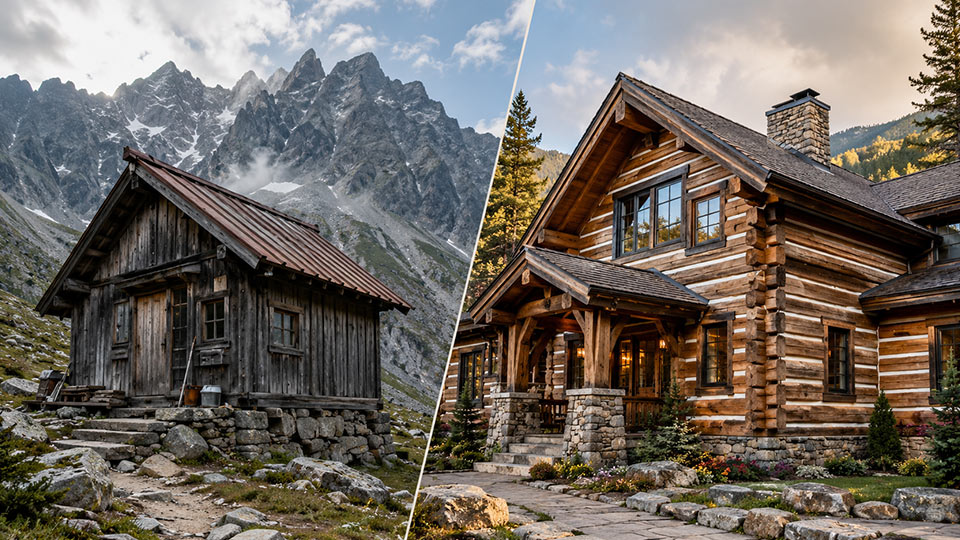
When people see a wooden building in the mountains, they may describe it as either a mountain hut or a log home.
Both can be surrounded by nature, feature steep roofs, and look perfectly suited to a wood-burning stove. Because of these similarities, the two terms are often used as though they mean the same thing.
In reality, however, they refer to very different types of buildings.
A mountain hut is generally associated with a simple, practical shelter for hikers and climbers. A log home, by contrast, is usually imagined as a private residence or vacation home designed for comfortable living in nature.
So what is the actual difference?
A Mountain Hut Is Defined Mainly by Its Location and Purpose
A mountain hut is a building located in a mountainous area and used primarily as a shelter, rest stop, or overnight facility for hikers.
Its role is less like that of a private home and more like that of a practical support facility in a remote environment.
The term often brings to mind:
- A remote mountain location
- A small, compact building
- Basic facilities
- Simple and practical interiors
- Shared accommodation
- Limited access to water or electricity
- Durability and function taking priority over luxury
A mountain hut is not defined by a specific construction method.
It may be built from timber, steel, masonry, or concrete. It does not have to be made from logs.
What matters most is not how it is built, but where it is located and what it is used for.
A Log Home Is Defined by Its Construction System
A log home, on the other hand, is defined by the way its walls are built.
The exterior walls are made by stacking horizontal logs. Depending on the design, those logs may be round, square, solid, laminated, or shaped with dovetail corner joints.
The term “log home” often suggests:
- Warm interiors surrounded by wood
- A wood-burning stove or fireplace
- A vacation home in nature
- Deep roof overhangs
- A porch or deck
- Open and relaxing interiors
- A house that develops character over time
Unlike a mountain hut, a log home does not have to be built in the mountains.
It can be constructed near the sea, beside a lake, in the countryside, in a resort area, or even in a residential neighborhood. Log homes can be used as permanent residences, vacation homes, restaurants, shops, or accommodation facilities.
In simple terms:
- A mountain hut is defined mainly by location and purpose.
- A log home is defined mainly by construction method.
Why Are Log Homes Often Seen as Mountain Huts in Japan?
In Japan, log homes have long been associated with campgrounds, ski resorts, highland vacation areas, and tourist facilities.
As a result, many people still picture a log home as:
“a small wooden house in the mountains.”
Early log homes in Japan were often compact, simple, and strongly rustic in appearance. Many used round logs and basic layouts, which reinforced the image of a mountain cabin or campsite cottage.
Modern log homes, however, have evolved considerably.
With proper insulation, airtightness, windows, ventilation, heating, cooling, and structural planning, a contemporary log home can provide the same level of comfort expected from a high-quality modern residence.
A Mountain-Hut Aesthetic Is Not Necessarily a Disadvantage
Some people associate the word “mountain hut” with something old, cramped, or inconvenient.
However, the simplicity of mountain huts can also be part of their appeal.
Their character often comes from:
- Minimal decoration
- Honest use of natural materials
- Compact and efficient layouts
- A strong connection to fire and warmth
- A close relationship with the surrounding landscape
Today, many architects reinterpret these ideas in modern cabins and mountain homes.
A house can look simple and rustic on the outside while still including high-performance insulation, underfloor heating, a modern kitchen, large windows, and comfortable bathrooms.
A mountain-hut appearance and modern residential comfort do not have to conflict.
“Mountain Hut,” “Log Cabin,” and “Log Home” in English
In English-speaking countries, the terminology also varies.
A mountain hut usually refers to a simple shelter or lodging facility for hikers and climbers.
A cabin is a broader term. It often describes a small holiday home, rural retreat, or modest wooden building.
A log cabin usually refers to a smaller and more rustic building made from logs.
A log home suggests a more substantial residence built using log construction.
This distinction is important when describing wooden homes in Japan to international clients.
Calling a high-quality custom residence a “mountain hut” may make it sound too basic. Depending on the design, more suitable terms may include:
- Log home
- Dovetail log home
- Timber frame home
- Mountain retreat
- Country home
- Rustic residence
Episode 1 Summary
Mountain huts and log homes may look similar, but the terms are based on different ideas.
A mountain hut is defined mainly by its location and function. A log home is defined by the way its walls are constructed.
A log home built in the mountains may look like a mountain hut, but a modern log home can be a fully equipped permanent residence or high-quality vacation home.
In Episode 2, we look at how different construction systems—including round logs, laminated logs, dovetail logs, and timber framing—create very different architectural styles and living experiences.









