What Is the Difference Between a Mountain Hut and a Log Home?【Ep.2】
How Construction Style Changes the Character of a Wooden Home
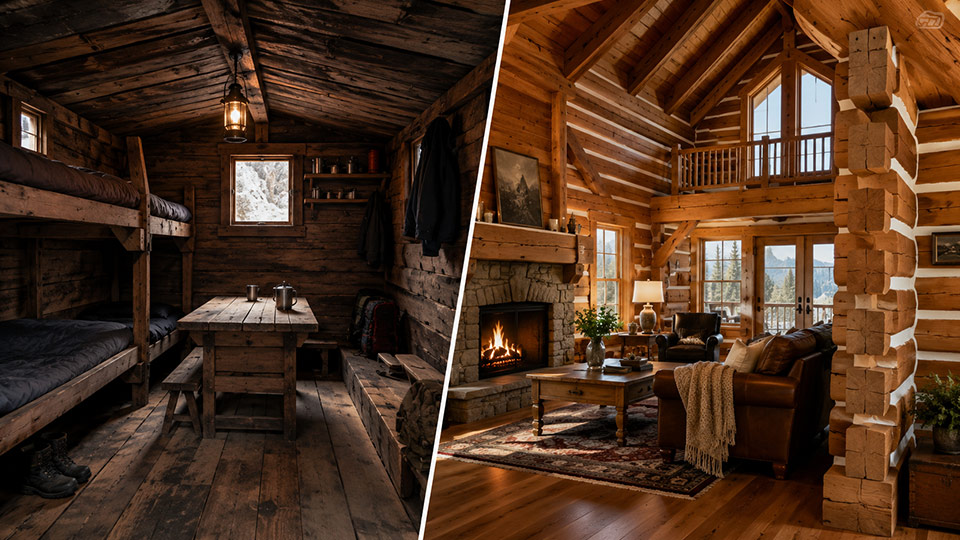
In Part 1, we explained that a mountain hut is defined mainly by its location and purpose, while a log home is defined by its construction system.
However, when people are choosing a wooden home, they are usually less concerned with definitions and more interested in one practical question:
“What kind of atmosphere will each construction style create?”
Even among log homes, the appearance and character can vary greatly depending on the type of logs, the surface finish, and the structural system.
Round Log Homes
Round log homes use logs that retain their circular form.
They have a strong visual presence and are probably the closest to what many people imagine when they hear the words “log cabin in the forest.”
They often create an impression that is:
- Rustic
- Powerful
- Natural
- Canadian or North American
- Closely associated with mountain cabins
- Strongly connected to the surrounding landscape
When large-diameter logs are used, the result can feel substantial and impressive.
Smaller-diameter round logs, however, may create an appearance closer to a campsite cabin or simple holiday cottage.
Laminated Log Homes
Laminated logs are manufactured by bonding multiple pieces of timber together.
They tend to be dimensionally stable, uniform, and easy to work with.
Their appearance is usually:
- Scandinavian
- Clean
- Bright
- Neat and consistent
- Suitable for residential areas
- Well suited to modern vacation homes
Because the surface is smooth and uniform, laminated logs often look more refined and less rugged than round logs.
They may feel closer to a Nordic timber house than to a traditional mountain hut.
Dovetail Log Homes
A dovetail log home is built from large square logs joined at the corners with dovetail-shaped notches.
The combination of heavy square logs and visible chinking creates a substantial, historic appearance.
Rather than resembling a simple mountain hut, a dovetail log home may bring to mind:
- An early American farmhouse
- A pioneer-era residence
- A country estate
- A historic timber home
- A substantial mountain residence
Dovetail construction is particularly well suited to large timbers, hand-hewn surfaces, and antique finishes.
These treatments add depth, shadow, and character to the wood, making the house appear more mature and distinctive over time.
Dovetail log walls can also incorporate insulation between the logs, allowing the traditional appearance to be combined with modern thermal performance.
Timber Frame Homes Bridge Rustic Character and Modern Comfort
Timber frame construction uses large posts and beams connected through traditional joints and wooden pegs.
Unlike a log home, the walls are not built by stacking logs. However, the exposed structural frame creates a strong visual connection to lodges, barns, and mountain architecture.
At the same time, timber frame construction allows insulation panels to be installed outside the structural frame, making it easier to achieve modern levels of energy efficiency.
A timber frame home can include:
- Large windows
- Double-height living spaces
- Exposed trusses
- Hammer-beam structures
- Open-plan interiors
- Dramatic timber ceilings
With these features, the result feels less like a simple mountain hut and more like a high-end mountain retreat.
Timber framing can therefore combine the strength and atmosphere of traditional mountain architecture with the comfort and openness of a modern home.
Does a Log Home Become a Mountain Hut Simply Because It Is Built in the Mountains?
In everyday conversation, a log home in a mountain area may be described as a mountain hut or cabin.
However, if it is designed as a permanent residence or vacation home with a kitchen, bathroom, insulation, heating, cooling, and modern utilities, it is more accurately described as a log home in the mountains.
Conversely, a building does not need to be made from logs to be a mountain hut.
A simple shelter for hikers is still a mountain hut even if it is built from conventional timber framing, steel, or concrete.
The terms can be summarized as follows:
- Mountain hut: defined mainly by location and purpose
- Log home: defined by stacked-log wall construction
- Timber frame home: defined by a structural post-and-beam system
- Cabin: often a small, simple holiday or rural building
- Cottage: often an independent small home used for holidays or accommodation
These terms may overlap, but they are not interchangeable.
Choosing the Image You Want
When planning a wooden home, it is useful to think beyond the general idea of “a house made of wood.”
Do you want:
- A simple, rustic mountain-hut atmosphere?
- A Canadian-style round-log cabin?
- A historic dovetail log home?
- A bright Scandinavian-style laminated-log house?
- A spacious and refined timber frame residence?
The image you want will affect almost every design decision, including:
- Timber size
- Surface finish
- Roof shape
- Window design
- Floor plan
- Interior volume
- Heating and cooling
- Exterior materials
A home can look rustic on the outside while being modern and highly comfortable inside.
It is also possible to create a refined exterior while introducing rough-hewn timbers, a stone fireplace, or other rustic features inside.
Rustic Character and Modern Performance Can Coexist
A home does not have to choose between traditional appearance and modern comfort.
With proper insulation, airtightness, windows, ventilation, roofing, heating, and cooling, a wooden home can retain the character of a mountain cabin while still performing as a modern residence.
Dovetail log homes and timber frame homes are particularly well suited to this approach because they can offer:
- Large exposed timbers
- Deep roof overhangs
- Strong compatibility with fireplaces and wood stoves
- A natural fit with mountain and forest settings
- The ability to incorporate modern insulation systems
This makes them attractive choices for people who want the atmosphere and strength of traditional mountain architecture without sacrificing residential comfort.
Conclusion
Mountain huts and log homes may share a similar rustic appearance, but they are not the same type of building.
A mountain hut is usually a practical facility located in the mountains, while a log home is a building constructed with stacked log walls.
Within the category of log homes, round logs, laminated logs, and dovetail logs each create a different visual character.
Timber frame construction expands the possibilities even further, ranging from simple cabin-inspired homes to spacious, high-end mountain retreats.
The most important question is not whether a building should be called a mountain hut or a log home.
What matters is how you want to live, where you want to build, and what kind of atmosphere you want the home to develop over time.
Once that vision becomes clear, the right construction system and design direction also become much easier to identify.









