Why Ground Stability Testing is Important for Log Home Construction【Ep.1】
Hidden Land Risks You Can’t See and What Surface Wave Testing Really Tells You.
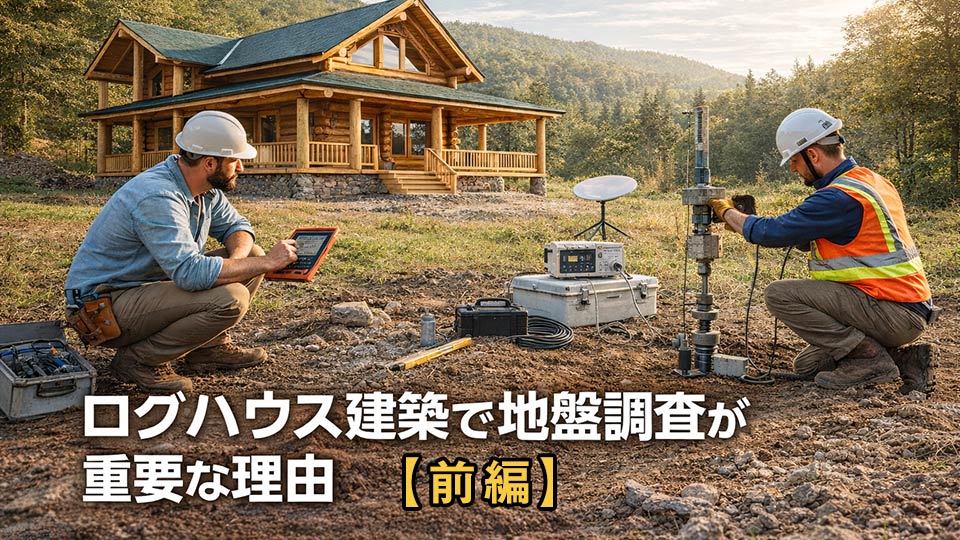
When planning to build a log home, most people naturally focus on the visible aspects—design, layout, wood materials, and the atmosphere of the location.
The idea of living in a wooden home surrounded by nature is undeniably appealing, and that is exactly what makes log homes so attractive.
However, if you want to build a log home that is safe and comfortable for the long term, there is something even more important to check before the building itself.
That is ground stability testing.
No matter how beautiful the design is, if the ground supporting the house is weak, various structural issues may arise over time.
This is especially important for log homes, which are often built in suburban areas, mountainous regions, or sloped land—locations where ground conditions are not always obvious from the surface.
In this first episode, we will explain why ground investigation is essential for log home construction and introduce surface wave testing, a commonly used method in the early stage of planning.
Why Ground Stability Matters in Log Home Construction
Every house stands on a foundation, and that foundation is supported by the ground beneath it.
In other words, the stability of a building depends not only on what you can see, but also on the condition of the ground you cannot see.
If a house is built on weak ground, the following issues may occur:
- Uneven settlement of the building
- Cracks in the foundation
- Doors and windows becoming difficult to open or close
- Floors losing level alignment
- Structural distortion over time
These problems are difficult and expensive to fix after construction.
That is why understanding the ground condition before building is essential.
While log homes are often appreciated for their warmth and design, their true value can only be realized when they are built on a stable foundation.
You Cannot Judge Land Safety by Appearance Alone
When visiting a site, it is common to think:
- “It looks flat, so it should be fine.”
- “There used to be a house here, so it must be stable.”
- “The view is nice and the land looks well maintained.”
However, surface appearance does not necessarily reflect actual ground strength.
For example, potential hidden risks may exist in:
- sloped or mountainous land
- land with past filling or grading work
- sites where buildings previously existed
- areas where debris or uneven soil layers remain underground
Especially in nature-rich areas, the ground may appear stable on the surface while conditions vary significantly below.
Even if a structure existed in the past, that alone does not guarantee current stability, as soil conditions may have changed over time.
In short, when building a log home,
a visually attractive site does not automatically mean structurally reliable ground.
Why Ground Conditions Are Especially Important for Log Homes
Like any house, a log home is built on a foundation.
However, log homes are often designed as long-lasting, natural-material residences, which makes long-term stability even more important.
Most people interested in log homes are not looking for a short-term residence.
They want a home they can live in for many years, often in harmony with nature.
For that reason, it is not enough to focus only on design or materials.
It is equally important to consider whether the house can remain structurally stable over time.
In addition, log homes are often built in locations that differ from standard urban residential plots.
Ground conditions may vary across the site, especially on sloped land or areas with prior earthwork.
This makes proper ground investigation even more critical.
What Is Surface Wave Ground Testing?
One of the commonly used methods in the early stage of log home planning is surface wave testing.
This method works by generating vibrations on the ground surface and analyzing how those waves travel through the soil.
By measuring wave speed, it is possible to estimate the relative hardness or softness of underground layers.
In simple terms, this test helps to:
identify the general characteristics of the ground and highlight areas that may require attention.
Its main advantage is that it provides a broad overview of ground conditions across the site.
It is particularly useful for understanding:
- variations in ground stiffness
- areas that may be weaker
- general tendencies that could affect building plans
The Role of Surface Wave Testing
Although surface wave testing is a very useful method, it does not provide all answers at once.
Its role is to give a general understanding of the site as a whole.
In other words, it helps answer questions like:
- “What is the overall condition of this land?”
- “Are there any areas that may require closer attention?”
It can be compared to a general health check-up.
It identifies potential concerns but does not replace detailed, location-specific testing.
Importantly, this method does not directly test every exact point where the foundation will sit.
As the design progresses and the building layout becomes more defined, more detailed testing may be required.
Why This Is Sufficient in the Early Stage
In the early stages of planning, key elements of the house are often not fully decided, such as:
- building size
- orientation
- foundation type
- porch and deck positions
- stair locations
At this stage, the goal is to understand:
“What kind of building plan is realistic for this land?”
Surface wave testing is suitable because it provides a broad understanding without requiring finalized design details.
On the other hand, conducting highly detailed testing based on exact load points is not practical at this stage, since:
the exact load distribution is not yet determined.
That information only becomes clear as the design progresses.
Ground Investigation Is Not an “Extra Cost”
When building a home, it is natural to want to minimize costs.
Some people may view ground investigation as something they would prefer to avoid.
However, in reality, ground testing is not an unnecessary expense.
It is a critical step before foundation construction, which cannot be easily reversed.
If problems such as settlement or foundation damage are discovered after construction, repairs can be extremely costly and complex.
Compared to that, obtaining accurate ground information beforehand is a highly rational decision.
For a long-term home like a log house, ground investigation should be seen not as an extra cost, but as an investment in long-term safety and stability.
Summary (Episode 1)
A Good Log Home Starts with Understanding What Lies Beneath
When building a log home, it is important to look beyond design and materials and first understand the ground conditions.
Surface wave testing plays a key role in identifying the overall characteristics of the land and highlighting potential concerns that are not visible on the surface.
However, ground evaluation does not end at this stage.
As the building layout, foundation positions, and load conditions become more defined, further detailed investigation may be required.
In Episode 2, we will explain:
- what the Swedish Weight Sounding Test is
- how it differs from surface wave testing
- why it is not possible to determine everything in advance









