How to Maximize Grants and Subsidies for Log Home Construction in Japan【Ep.1】
A Fundamental Strategy for Meeting the 2030 Insulation Standards
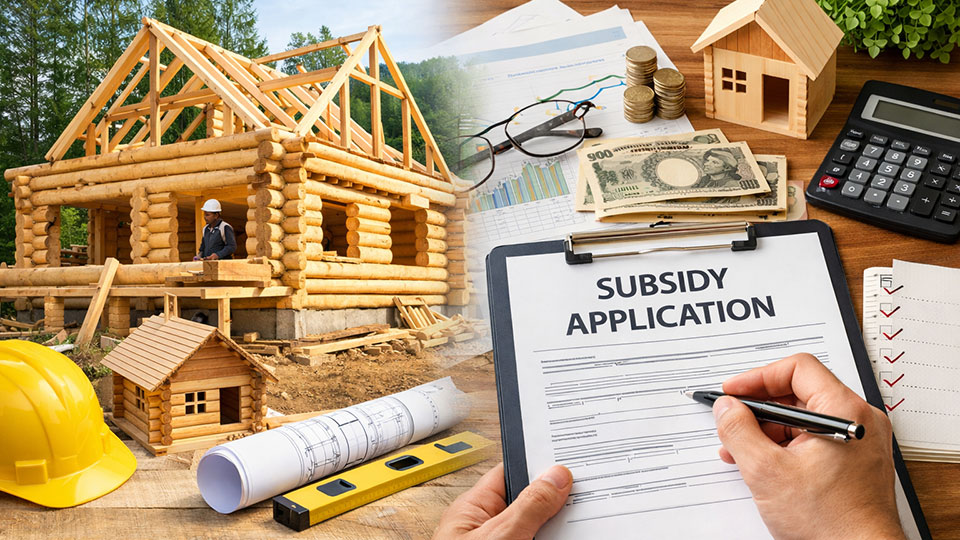
Leveraging Grants and Subsidies in Japanese Log Home Construction – Episode 1
“I want to build a log home, but can I really use grants or subsidies?”
This is one of the most common questions we hear today. Behind it lies a major shift in Japan’s housing policy, which is increasingly moving toward high-insulation, high-performance homes in preparation for 2030.
The short answer is yes: even dovetail log homes and timber frame houses can fully take advantage of grants and subsidy programs.
However, doing so requires rethinking the traditional approach of “looking for subsidies after the house design is finalized.”
Grants Are Not Something You Look for “Afterward”
One of the defining characteristics of grant and subsidy programs is that most require applications to be submitted before construction begins, along with performance verification at the design stage.
In other words, once:
- the floor plan is finalized
- specifications are fixed
- and estimates are completed
the number of available programs drops dramatically.
To successfully use subsidies in log home construction, it is essential to
👉 plan from the very beginning with the assumption that grants and subsidies will be used.
The Relationship Between 2030 Insulation Standards and Subsidies
As Japan looks toward 2030, insulation performance equivalent to Grades 6–7 is effectively becoming the new benchmark.
National housing subsidies are designed to encourage homes that meet—or aim to meet—this level of performance.
A critical point to understand is this:
subsidies are not determined by whether a house is a “log home” or not.
Instead, evaluation is based strictly on measurable criteria such as:
- insulation performance
- primary energy consumption
- equipment specifications
In other words, numerical performance values and design details are what matter.
Why Log Homes Can Qualify for Subsidies
Dovetail Log Homes
Dovetail log homes are built using thick solid timber joined with highly precise connections, giving them:
- excellent thermal mass
- a structure that makes airtightness easier to achieve
With proper insulation planning for the roof, floors, and openings, it is entirely possible to meet the performance standards required for subsidies.
Timber Frame Homes
Timber frame construction uses posts and beams as the structural system, allowing the insulation layer to be designed independently.
From a subsidy-compliance standpoint, this makes timber frame construction an extremely rational and flexible method.
National Subsidies Are “Funding to Achieve Performance”
National housing subsidies—such as those related to ZEH and energy-efficient housing—exist as incentives to promote highly insulated homes.
What matters most is this mindset:
- not lowering performance just to qualify for subsidies
- but receiving subsidies as a result of achieving the required performance
In log home construction, getting this order right is the first step toward success.
Bridging to Episode 2
When it comes to using grants and subsidies in log home construction, the key is not simply asking “Are they available?”
Rather, it is about how they can be combined and how the project is advanced strategically.
By understanding subsidy systems from the early design phase and organizing both performance goals and planning accordingly, log homes can fully qualify as subsidy-eligible housing.
In Episode 2, we will explore how to combine national programs with local government subsidies and regional relocation support, and provide a detailed, practical guide to maximizing grants and subsidies in real log home projects.